
Before I share our experiences in Palma de Mallorca, let me recount how we unexpectedly arrived there.
After a month of enjoying a productive and comfortable stay at Port de Hyères Marina, we had to move on due to the 90-day limit of the Schengen visa. As Americans, we can stay in the Schengen Zone for up to 90 days within 180 days without a long-stay visa. With time running out, we had about four weeks to travel from France to the Canary Islands, and the clock was ticking.
We selected a weather window that appeared suitable for sailing south, relying on various weather and wind prediction tools (Windy.com and Predictwind.com). We anticipated brisk northwest winds of 20 to 25 knots and planned a 5- to 6-day passage to Gibraltar. This would be our first leg of bringing Juno to the Caribbean.
As soon as we left the protection of the harbor, we encountered a confused sea with short, steep waves. Having spent over six weeks in marinas, we had completely lost our beginner sea legs! There’s a common saying among sailors: it’s the waves, not the wind, that break a sailor. Unfortunately, the conditions were much worse than we expected. Robert got seasick within the first hour of our passage, and I managed to hold on for a couple more hours before giving in and losing my breakfast. Meanwhile, the conditions deteriorated further. The wind picked up, and the sea grew increasingly rough, blowing consistently over 30 knots. We considered turning back, but that would mean beating into the 30+ knot wind, which we knew would be impossible. So, we pressed on, hoping that the weather would improve. As night fell, the situation worsened. Thankfully, we had a small enclosure that kept us relatively warm and dry. By midnight, the wind consistently reached over 45 knots, with the worst gusts exceeding 55 knots. We found ourselves caught in an unforecasted gale-force storm, a winter mistral.
Robert had furled the mainsail completely many hours earlier and had now reduced the headsail to a tiny triangle. Yet, we were still surfing down the waves, sailing at over 11 knots. At this point, everything in the cockpit was wet, as large waves washed in through zippers and small openings in the enclosure. It was a pitch-black night with no moon, and the tiny, enclosed area felt like our entire universe. Moving around the boat became very difficult. And the noise from the hauling wind, crushing waves, and clunking halyards was deafening.
To make matters worse, our newly installed wind instrument provided incorrect wind direction, adding confusion and disorientation to an already surreal experience. Looking back, I wasn’t frightened and didn’t feel we were in real danger, as Juno felt solid and in control. However, I certainly prayed for the experience to end quickly! I had never been so happy to see daybreak!
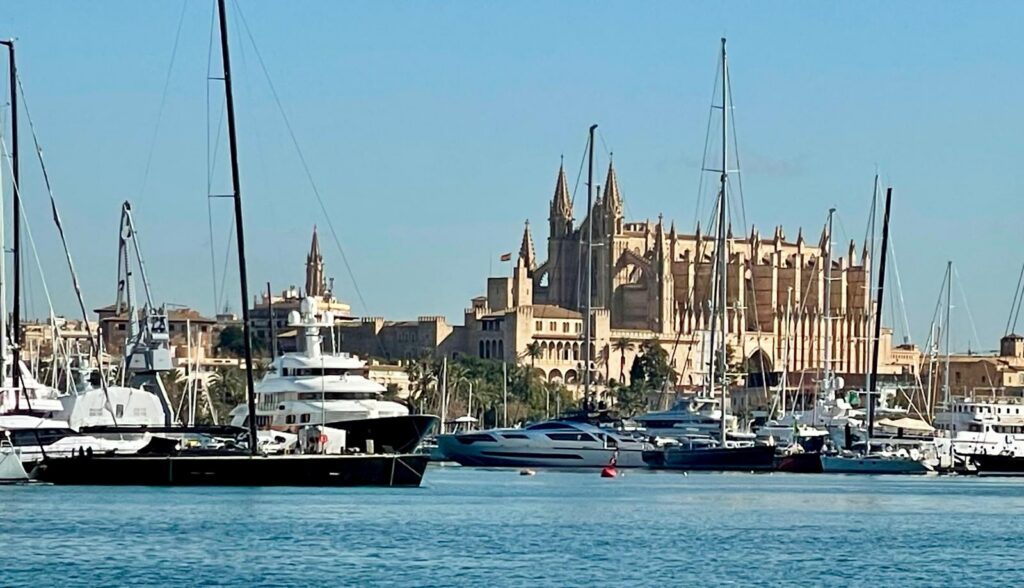
Once the sun rose, we felt much better. However, the wind was still blowing over 30 knots, and the sea remained rough. The island of Mallorca was about a day’s sail away, so we decided to change our plans and seek a safe harbor for a few days. As we approached Palma, Mallorca, the sun had already set, and we spotted the famous Catedral-Basilica de Santa María de Mallorca in the twilight. Fortunately, Real Club Náutico de Palma had a slip available for us since January is the low season. The dock staff were excellent. We were greeted by two inflatable dinghies and a dockhand on the pier. We carefully pulled into our slip in the dark and looked forward to a good night’s sleep after 36 hours of tough sailing.
The journey from Hyères to Palma confirmed that we had made the right choice in selecting our boat. I was grateful for Juno’s center-cockpit design, which allowed us to manage all our sails safely from the cockpit. It would have been frightening to have to climb to the foredeck to reef the sails during the conditions we were experiencing.
Leave a Reply